You had the vision. Now it's time to build the team that will make every day count.

You probably have a version of this company in your head that is much bigger than the one you're running today. Good.

The work is connecting that ambition to what happens now. Which customers you pursue. What you build. Where you spend. Who you hire. What only you can own, and what deserves another quarter of your life.

I work with early-stage founders on that operating system: long-term ambition turned into clearer priorities, better decisions, and the capacity that enables scaling.

WHAT'S YOUR BIGGEST OBSTACLE?
The moments that define a company

Traction changes the founder's job.

Early on, the line between effort and progress is pretty direct.

You make the call. You close the customer. You fix the product. You answer the email. If something important needs to happen, you can usually make it happen yourself.

Then the company starts working.

Now there are more customers than you can know personally. More good ideas than you can pursue. A team that needs answers from you while you're still finding your own. Enough money to make meaningful bets, and not enough to make all of them.

The work changes.

  • The customer conversation you decide to have.
  • The product you decide not to build.
  • The person you hire before you desperately need them.
  • The meeting you stop attending.
  • The priority everyone can finally repeat.
  • The difficult conversation you have on Thursday instead of carrying it for another quarter.

None of those decisions looks like the five-year vision.

Together, they are the five-year vision.

This is where I work with founders.

Not on creating more ambition. Most founders have plenty.

I work with founders at the point where the company has traction, the choices are getting harder, and the way they operated to get here won't get them where they want to go next.

The work is turning ambition into a small number of consequential priorities, and then making sure the decisions you make this quarter, this week, and on any given morning actually serve them.

That means getting specific.

What has to be true for this company to win?

What can you actually control? Which customers matter most? What are you learning from them? Which opportunities are distractions in disguise? Where does the company still need you, and where are you now getting in its way? Which bet unlocks the next six months?

There will never be enough information to make those questions easy.

But you can build a much better way to answer them.

I've spent twenty years building and operating a recurring-revenue business and eighteen months working alongside more than a thousand high-growth founders at Hampton.

Different companies. Different markets. Different ambitions.

But I kept seeing the same pattern: good companies rarely lose their way through one obviously bad decision. They drift through hundreds of reasonable ones that, over time, stop adding up to the company the founder set out to build.

The answer isn't a better five-year plan.

It's building the clarity, discipline, and operating rhythm to make today's decisions compound toward it.

Because great companies aren't built in a day. They're built in ordinary weeks, stacked over time.

Patrick
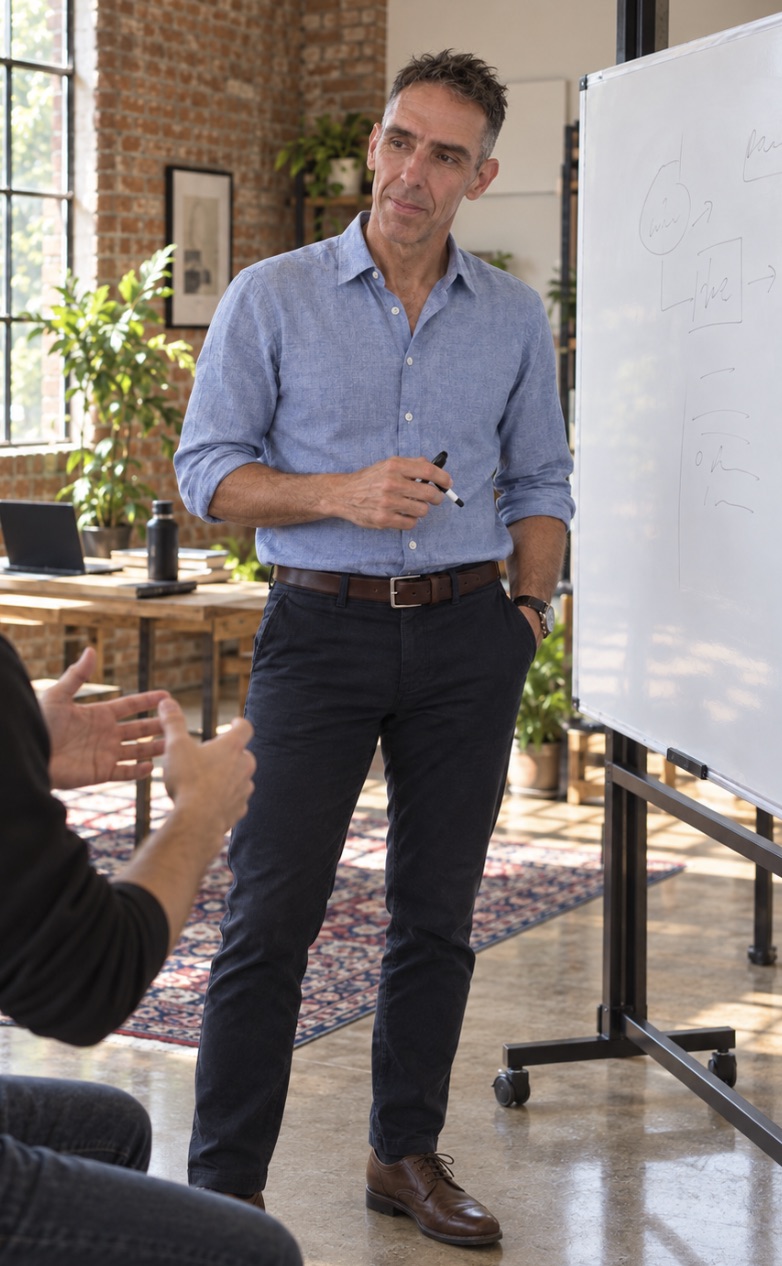
Patrick McCrann working at a whiteboard with founders
Patrick McCrann · Operator, founder coach, endurance athlete
On the other side of the table
  • 1,000+ foundersworked alongside high-growth founders at Hampton
  • 18 monthsinside a community of ambitious founders building at scale
  • Founder curriculumhelped design and teach the curriculum built to make founders better operators and better humans
  • Twenty yearsbuilding and operating a recurring-revenue business
  • Endurance operatordecades building systems around performance that has to last
  • Coach + operatorworking on the person, the decisions, and the company at the same time
In the room right now

Pre-Seed. Early stage.
Long-term vision.

I keep a small number of advisory seats open for pre-seed founders who want a practitioner in the room, not another opinion. Here's what that looks like today.

A youth sports platform

Pre-seed · Two co-founders

A live product, a few dozen early users, and a go-to-market that runs one competition at a time. The product is the communication loop between coach, parent, and athlete, and the founders' bet is that community makes it sticky, not features.

A mountain-bike-first lodging concept

Pre-seed · Solo founder

A founder building places to stay designed around riders instead of retrofitted for them. The value I bring is decades of traveling with bikes and knowing which amenities are real and which are decorative.

Neither company needed a framework. They needed someone who has done the thing to look at the plan and say what's missing.

What the work actually looks like

The bigger the vision, the more specificity matters.

There isn't one founder playbook because there isn't one founder problem.

Sometimes the company has more opportunities than conviction. Sometimes the customer is still too broadly defined. Sometimes sales work, but only when the founder is doing the selling. Sometimes the right next hire isn't obvious because the founder hasn't decided what to stop owning.

And sometimes the company is fine. The founder just needs a place to say what they actually think before they have to sound certain for everyone else.

The work starts with the company you're trying to build and works backward. What needs to be true three years from now? What would have to be true twelve months from now for that future to stay plausible? What matters this quarter? What are you actually doing this week to move it?

From there, we work on the real thing in front of you. A customer decision. A product bet. Pipeline. The first leadership hire. A co-founder disagreement. How capital gets deployed. A role you need to stop playing. A conversation you're avoiding. A team waiting for clarity. Or four good opportunities and enough capacity to pursue one of them properly.

The output isn't another plan. It's a clearer game, and a way to operate inside it. The ambition can be enormous. The next move still has to happen on Tuesday.

When to bring me in

The company is asking something different of you now.

  • 01 You know what you're trying to build, but the line between the long-term goal and this quarter's priorities has gotten fuzzy.
  • 02 There are three credible opportunities in front of you. You can afford to pursue one well.
  • 03 You have customers, but you're still figuring out which customer should define the company.
  • 04 The pipeline exists, but too much of it still depends on your energy, your relationships, or your improvisation.
  • 05 You're about to make a hire that changes what you own, and what the company can expect from you.
  • 06 Your team is good, but too many important decisions still come back to you.
  • 07 You and your co-founder agree on the destination and are discovering that agreeing on the destination isn't enough.
  • 08 You have a board meeting, an investor conversation, a product commitment, or a people decision coming up and want somewhere to think before you have to perform certainty.

Or maybe nothing is broken. The company is simply working well enough that how you lead it next matters.

The operating system

Ambition only compounds when the weeks connect.

I don't come in with a framework and tell you how startups work. We start with what you actually want to build.

Then we make the path more explicit: the assumptions underneath it, the constraints around it, the few things that matter now, and the activities you can control.

From there, we build a rhythm for learning and deciding. What did we say mattered? What happened? What did customers actually tell us? What changed? What are we doing because the evidence supports it, and what are we doing because it's uncomfortable to stop?

Over time those conversations become more than decisions. They become an operating system. A way to connect the long game to the quarter, the quarter to the week, and the week to what you actually do.

And as the company grows, the system grows beyond you. Clearer ownership. Stronger people. Better decisions made closer to the work. More capacity to pursue the ambition.

The goal isn't to make the founder less important. It's to make the whole company more capable.

Ways to work together

A sounding board and second brain for the work only the founder can own

Being a founder creates an unusual problem. Your investors can give you advice, but they're investors. Your team needs you to lead. Your co-founder is inside the problem with you. Your family shouldn't have to become your board. And most people giving startup advice only see one piece of the company.

There are remarkably few places where you can put the whole thing on the table. That's what this work is for. We meet regularly around the decisions actually shaping the company: customers, product, people, capital, priorities, leadership, and your own role as it changes.

Sometimes I'll coach. Sometimes I'll draw on operating experience. Sometimes I'll ask the question you don't particularly want asked. And sometimes I'll tell you I think you're solving the wrong problem.

The objective is the same every time: connect the company you want to build to the way you're building it now.

For the founder

One-on-one founder coaching

An ongoing partnership for founders building through an inflection point.

We establish the long game, identify what matters now, and use regular sessions to work through live decisions while building a stronger way of operating over time.

The company becomes more capable because you are becoming more capable, not because you added an advisor who has to stay in every decision.

For founding teams

A focused founder working session

For a consequential decision or moment that needs more than another meeting.

We get the real issue on the table, pressure-test the assumptions underneath it, and leave with a decision, ownership, and a clear next move.

It can stand on its own or become the start of longer work.

For investors

You backed the ambition. Help build the capacity to match it.

The best time to invest in a founder's operating capacity isn't when something has gone wrong.

It's while the company is working and the founder's role is changing underneath them. I work directly and confidentially with founders.

The objective is simple: stronger judgment, more capable leadership, and a company increasingly able to turn ambition into execution.

Building something that could take a decade?

Start with the obstacle.

Bring me the thing you're working through right now. We'll spend 2 hours on the actual problem, not your pitch deck, and see whether the way I work is useful to you.

WHAT'S YOUR CURRENT OBSTACLE?

Confidential by default.